
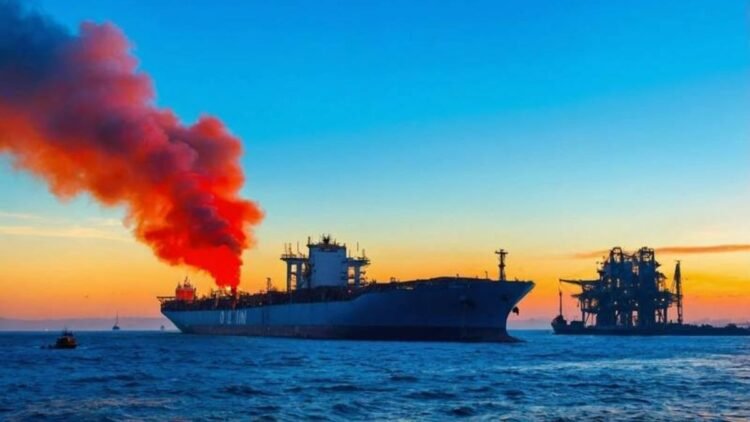
As the conflict in the Middle East continues, global oil prices have surged while stock markets have suffered significant losses. The latest flare-up in tensions, driven by Iranian strikes on vessels near the Strait of Hormuz, has sent shockwaves across financial markets, pushing the cost of oil up and affecting global shares.
Meanwhile, safe-haven assets like gold have seen a rise, and analysts are closely monitoring developments for further price movements.
Oil Prices Surge Amid Rising Tensions
Over the weekend, Brent crude, the global benchmark for oil prices, jumped by 10%, reaching more than $82 a barrel after at least three ships were attacked near the Strait of Hormuz.
This critical waterway is responsible for transporting around 20% of the world’s oil and gas. With ongoing military tensions, Iran has warned vessels not to pass through the strait, significantly impacting global shipping and trade routes.
In response to these developments, natural gas prices also surged by as much as 25%, contributing to the growing concerns over global energy costs. As analysts warn of the potential for further disruptions, it is clear that rising geopolitical instability is driving oil prices higher, impacting consumers and industries worldwide.
Stock Markets Hit by Middle East Conflict
While oil prices surged, stock markets around the world reacted negatively, with leading indices plunging into the red. The FTSE 100 stock market index in London opened nearly 1% down, and shares in airlines fell sharply after airspace was closed across the Middle East.
This disruption has caused significant concern, as major global shipping routes and air travel corridors were severely affected.
Other European markets also faced larger drops. The CAC-40 in France fell by 1.6%, while Germany’s DAX dropped by 1.7%, reflecting the widespread anxiety over the ongoing conflict in the region. These market reactions highlight how sensitive global financial markets are to political instability and the impact it has on international trade.
Impact on Global Shipping and Transportation
The situation in the Strait of Hormuz has effectively led to a near standstill in international shipping. More than 150 tankers have dropped anchor in open waters beyond the strait, waiting for safe passage.
However, with the rising risks, especially in the face of Iran’s threats, some ships have opted to reroute, avoiding the area altogether.
Notably, Danish shipping group Maersk announced it would pause sailings through the Bab el-Mandeb Strait and the Suez Canal, instead rerouting ships around the Cape of Good Hope.
This precautionary measure, though necessary, will likely lead to delays and higher transportation costs, further exacerbating the global supply chain crisis.
Gold Prices Climb as Safe-Haven Asset
In the face of rising uncertainty, investors are flocking to gold, a traditional safe-haven asset. The price of gold surged by 2.3%, reaching $5,395.99 per ounce, reflecting investor concerns about further destabilization in the Middle East.
As financial markets react to geopolitical risks, gold continues to provide a hedge against the volatility in stocks and commodities.
Potential Economic Consequences of Rising Oil Prices
The surge in oil prices is not only impacting the cost of energy but is also poised to drive up prices in other sectors. Edmund King, president of the AA, warned that the disruptions in oil distribution across the Middle East would inevitably lead to higher petrol prices globally.
If oil prices remain elevated for a prolonged period, it could lead to widespread inflation, particularly in sectors such as food, agriculture, and industrial commodities.
In the UK, the impact of higher energy prices is being closely monitored, as Subitha Subramaniam, chief economist at Sarasin & Partners, pointed out that sustained high oil prices would “cascade into other prices” and significantly increase inflationary pressures.
Impact of Global Tensions on Key Prices
| Commodity | Change |
|---|---|
| Brent Crude Oil | +10% to $82 per barrel |
| Natural Gas | +25% |
| Gold | +2.3% to $5,395.99/oz |
| FTSE 100 | -1% |
| CAC-40 | -1.6% |
| DAX | -1.7% |
What Lies Ahead for Global Oil and Stock Markets?
The future of oil prices depends largely on the ongoing geopolitical situation. If tensions in the Middle East continue to escalate, there are fears that oil prices could spike to over $100 per barrel. This would likely have significant consequences for inflation and global economic stability.
While some analysts are confident that prices will stabilize if the Strait of Hormuz reopens and shipping resumes, others warn that a prolonged conflict could cause further volatility.
The Opec+ group, which includes major oil-producing nations, has agreed to increase output by 206,000 barrels per day to help cushion price hikes, but experts are divided on whether this will be enough to offset the supply disruptions.
As global tensions rise in the Middle East, oil prices continue to climb, affecting markets worldwide. With the threat of further disruptions, the situation remains volatile, and analysts are keeping a close eye on the potential impact on both energy prices and global financial markets.
While some hope for stabilization, the economic consequences of a prolonged conflict could be far-reaching, potentially driving inflation and increasing uncertainty across the globe.
FAQs
Why did oil prices rise so quickly?
Oil prices surged due to ongoing attacks on ships near the Strait of Hormuz, a key shipping route for oil and gas. Geopolitical tensions in the region are raising fears of prolonged disruptions to global oil supply.
How is the conflict affecting global stock markets?
Stock markets worldwide are reacting negatively to the uncertainty caused by the conflict. Major indices in Europe and the UK experienced significant losses, reflecting investor anxiety about the escalating situation.
How could high oil prices impact consumers?
Higher oil prices can lead to increased fuel costs, which in turn raises prices across various sectors, including transportation, food, and industrial goods. Prolonged high oil prices may contribute to inflation.